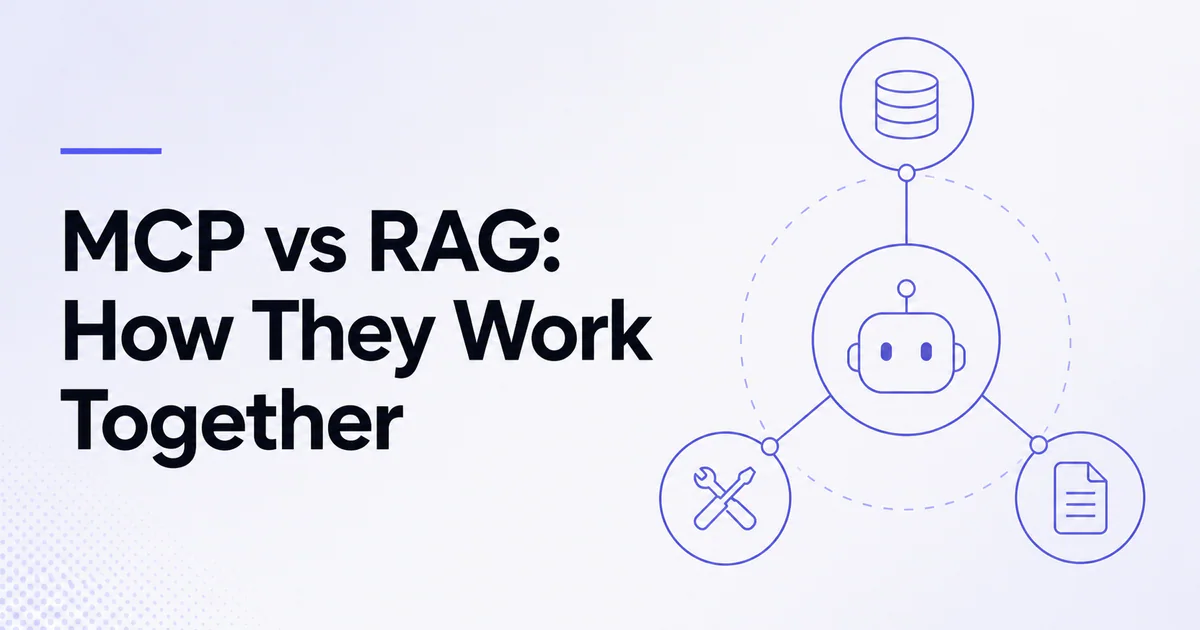
Quick answer: RAG is an application architecture that retrieves relevant knowledge and supplies it to a model before generation. MCP is a protocol for connecting AI hosts to external tools, resources and prompts. An MCP server can expose search and fetch tools that power RAG, but MCP also supports actions. RAG solves grounding; MCP solves integration portability.
The terms are sometimes treated as competing ways to “give AI context.” They operate at different layers. A RAG pipeline defines how information is selected and used. MCP defines how an AI application communicates with a server that may provide that information.
Comparison at a glance
| Dimension | RAG | MCP |
|---|---|---|
| Type | Application/retrieval architecture | Client-server integration protocol |
| Primary purpose | Ground generation in external knowledge | Connect hosts to capabilities |
| Core operation | Retrieve, rank and inject relevant content | Discover and invoke tools/resources/prompts |
| Data source | Search index, vector store, database or service | Any local or remote system behind server |
| Actions | Usually read-oriented | Read and write tools possible |
| Portability | Pipeline-specific | Server reusable across compatible hosts |
| Citation support | Designed into retrieval/result rendering | Server can return canonical source metadata |
| Security focus | Source authorization, injection, data leakage | Server trust, OAuth, tools, transport and data sharing |
What is RAG?
The original Retrieval-Augmented Generation research combines parametric model knowledge with external non-parametric memory retrieved for knowledge-intensive tasks. Modern RAG systems commonly:
- ingest and segment source content;
- create search representations;
- receive a user question;
- retrieve and rank relevant passages;
- provide them to the model;
- generate an answer with citations;
- evaluate retrieval and answer quality.
RAG can use keyword, vector, hybrid or structured search. The architecture is not defined by a specific database.
What is MCP?
MCP lets a host connect to servers and discover tools, resources and prompts. A documentation server might expose:
searchtool;fetchtool;- document resources;
- a research prompt template.
OpenAI's MCP server guide specifies search and fetch patterns with result IDs, titles and canonical URLs for company-knowledge and research compatibility.
Read what is MCP and how MCP works.
How MCP can power RAG
A combined flow:
- User asks a question in an AI host.
- Agent calls an MCP
searchtool. - Server queries a vector, keyword or hybrid index.
- Server returns ranked IDs, titles, snippets and URLs.
- Agent calls
fetchfor selected documents. - Server returns full or relevant content with metadata.
- Model produces a grounded answer with citations.
The RAG logic may live mostly inside the server, inside the host or across both. Define who controls query rewriting, ranking, filtering and source selection.
When RAG is enough
Use a direct RAG pipeline when:
- one application owns retrieval;
- the task is question answering or grounded generation;
- no portable server is needed;
- latency and ranking control are priorities;
- application-specific retrieval logic is a differentiator.
You can expose the retriever as an internal function without MCP.
When MCP adds value
Add MCP when:
- several AI clients need the same knowledge source;
- a data owner wants to publish a maintained interface;
- search and fetch should be portable;
- the same server also provides domain tools or prompts;
- access must work locally and remotely through standard transports;
- customers want to connect the knowledge base to their own compatible host.
MCP does not improve retrieval quality by itself. Poor chunking, ranking or metadata remain poor behind a standard interface.
Resources vs search tools
MCP resources are host- or user-selected readable objects. Search tools let a model or workflow dynamically query a source. Use resources when the relevant item is known or browsed; use search when selection depends on the question.
For large knowledge bases, do not list every document as a tool. Keep a small search/fetch surface and paginate or filter on the server.
RAG quality metrics
Evaluate:
- retrieval recall for relevant evidence;
- ranking quality;
- context precision;
- answer correctness;
- citation completeness and validity;
- freshness;
- abstention when evidence is absent;
- authorization correctness;
- latency and cost.
An agent evaluation adds trajectory, tool-selection and policy metrics. Use how to evaluate AI agents.
Security in combined systems
Source authorization
Filter retrieval by authenticated user and tenant before results reach the model. Do not retrieve broadly and ask the prompt to hide unauthorized records.
Indirect prompt injection
Documents can contain instructions designed to redirect the agent. Treat source text as untrusted data, restrict tools and require approval for actions.
Data sent to the server
Queries may contain sensitive conversation context. Minimize them and document what the MCP server receives and retains.
Citation URLs
Validate domains and do not automatically embed arbitrary URLs returned by a server. OpenAI's MCP safety guidance calls out URL handling specifically.
Tool authority
A knowledge server should be read-only unless write actions are truly required. Separate search from consequential operations.
Read MCP security best practices and AI agent security.
MCP, RAG and memory
RAG retrieves from an external corpus. Agent memory stores or reconstructs information from previous interactions or task state. An MCP server can provide access to either, but the data semantics differ.
Keep provenance:
- source document and version;
- retrieval timestamp;
- user or tenant scope;
- whether information is authoritative or inferred;
- retention and deletion policy.
IndieTools-listed dullnote describes an MCP-readable workspace with version history, illustrating how structured workspace context can become available to AI clients.
Architecture choices
| Need | Recommended pattern |
|---|---|
| One app answers from its docs | Internal RAG pipeline |
| Several agents need the same docs | RAG service exposed through MCP |
| Users choose individual files | MCP resources plus retrieval as needed |
| Agent must research and take action | MCP search/fetch plus separate action tools |
| High-throughput backend retrieval | Direct API may remain primary; MCP as agent interface |
MCP and direct APIs can coexist. Read MCP vs API for the layering decision.
Frequently asked questions
Does MCP include a vector database?
No. An MCP server can connect to a vector database, search engine, SQL database or any other source.
Does MCP make RAG more accurate?
Not by itself. Accuracy depends on ingestion, retrieval, ranking, authorization, context construction and model behavior.
Can RAG call tools?
A broader agent workflow can retrieve and call tools. RAG itself describes the retrieval-and-generation pattern, not the complete action system.
Should a knowledge MCP server expose search and fetch?
That is a useful compatibility pattern for research workflows. Define stable IDs, titles, canonical URLs and structured outputs as required by the intended clients.
 dullnote
 SEOReport
 OpenWeave
 Lynara