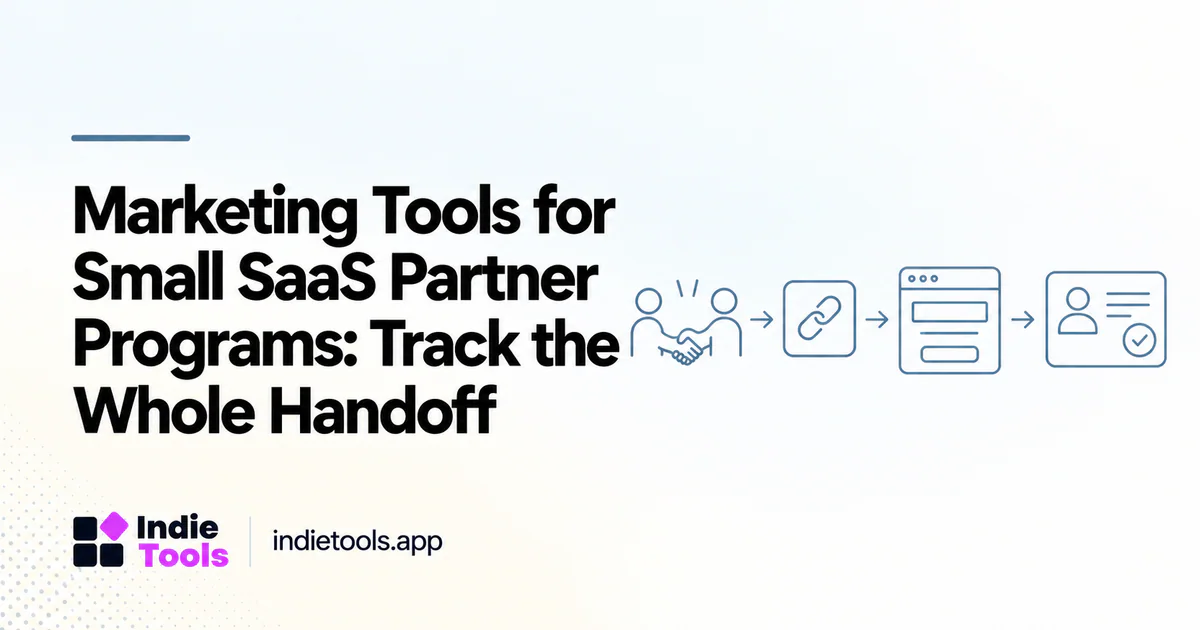
Select partner marketing tools around the handoff from a partner's recommendation to a qualified customer relationship. Link clicks alone are not enough. A small SaaS team needs to know which referrals are valid, what happened after signup and whether the promised reward can be calculated consistently.
This guide covers a small, permission-based partner program. It does not assume that every partnership needs affiliate software, nor that a larger partner list is automatically better than a few relevant relationships.
Choose the partnership model first
An affiliate recommends your product in exchange for a defined reward. A referral partner may introduce a specific customer and expect a different process. A technology partner may collaborate on an integration rather than receive a per-sale commission.
Write a one-page operating model before choosing tools. Define eligible referrals, the conversion event, the review process and the person responsible for resolving questions. Without this foundation, a dashboard can make ambiguous rules look precise while leaving the team to negotiate every edge case manually.
Match software to the payment workflow
Rewardful describes an affiliate and referral management platform for SaaS with native Stripe integration and commission management. [1] That makes payment compatibility an early evaluation question. It is not a reason to assume the same integration exists for every billing provider.
For products discovered through IndieTools' marketing category, verify the actual payment events supported. A tool may track a signup but not a later refund or plan change. Document which system is authoritative for a transaction and how corrections reach the partner report. [2]
Test a complete referral lifecycle
Use a controlled test account and a non-production payment workflow where available. Follow the path from partner link to signup, successful payment, cancellation and refund. Inspect how each event changes attribution and any pending reward.
Also test an existing customer clicking a partner link. The correct outcome depends on your published program rules, not on which result is most generous or easiest for the software. The purpose of testing is to find mismatches before a real partner depends on the report.
Give partners useful, current material
A partner portal should provide more than tracking links. Include a clear product description, relevant screenshots, approved factual claims and a route for asking questions. Keep the material aligned with the current product so partners do not repeat outdated pricing or promises.
Create a small change log for partner-facing updates. When a feature is removed or a trial changes, explain what should be updated in existing content. This process can be simple at the beginning; consistency matters more than a sophisticated portal with stale information.
Separate relationship quality from volume
Track whether introductions match the customers you can serve. A partner producing many low-fit trials can create support work without creating a sustainable relationship. Another partner may send fewer prospects who understand the product and activate successfully.
An illustrative review could group referrals by use case and examine their progression to a meaningful product action. Avoid presenting tiny samples as reliable rankings of partner quality. Use the observations to improve targeting and communication, not to make premature accusations about a partner's audience.
Review costs and disclosures
Include software fees, rewards, staff time and creative production in the experiment budget. A program that looks inexpensive per click may be costly once manual reconciliation and support are included.
When partner content contains paid links, Google provides link qualification guidance, including sponsored attributes. [3] Treat disclosure and link handling as part of a transparent relationship, not as an obstacle to obtaining ranking credit. Check applicable business requirements separately before launching payments across jurisdictions.
Questions before starting a pilot
Do five partners require a dedicated platform? Not necessarily. A controlled manual process may be sufficient when the rules and transaction volume are simple.
What should decide when to automate? Repeated reconciliation work, inconsistent reporting or a growing risk of missed updates are better signals than partner count alone.
What is a successful first pilot? A complete referral can be tracked and explained, both parties understand the rules, and the resulting customers fit the product. Expand only after that operating model works.
Explore related IndieTools resources: reported technology collections.
Continue your research
- Payment Provider Stacks: What Founders Disclose
- Directory Submission ROI: Measure What You Know
- Run a Small Directory Advertising Experiment
Sources and verification
Sources consulted for this article on October 1, 2026. Product capabilities are documented claims unless an actual test is explicitly described.