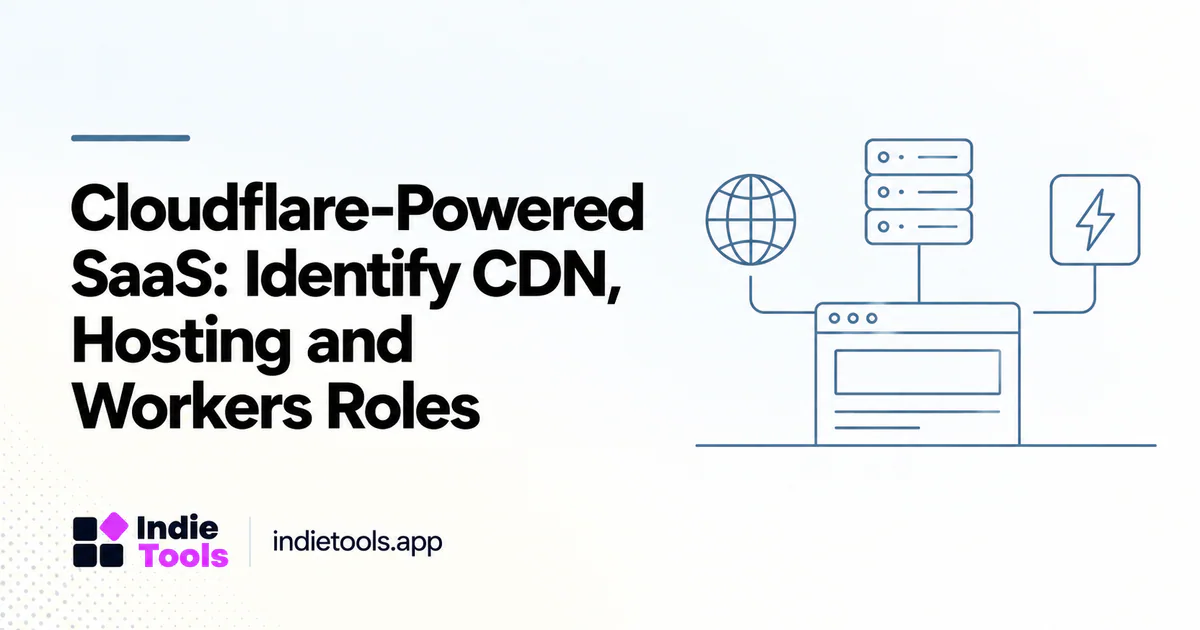
“Uses Cloudflare” is not a complete architecture description. Identify whether the product uses DNS, caching, application compute or another service, and record the role separately from the vendor name. Otherwise, a technology comparison may group very different systems under one label.
Cloudflare documents Cache and Workers as distinct capabilities. [1] [2] That distinction is enough to change the research question: a cached website and an application running compute at the edge are not interchangeable examples.
Draw the request path
Start with a visitor opening a public page. Identify the domain resolution, serving layer, origin application and any external APIs. Then draw a separate path for a dynamic action such as search or signup. The paths may share some components while differing at the most important step.
Do not infer the entire architecture from a response header. A visible provider can sit in front of several origins, and a public marketing site may use a different system from the authenticated product.
Classify each responsibility
Create fields for DNS, static delivery, cache, compute, storage and security services. Mark unknowns explicitly. A single generic technology tag is useful for broad discovery but insufficient for a technical comparison.
IndieTools' technology directory includes both Cloudflare and Cloudflare Workers as separate entries. [3] Use that distinction as a prompt to investigate the declared role, not as proof that all other components are absent.
Study caching with the right content
Separate public, reusable content from personalized or sensitive responses. An efficient public catalog cache does not imply that private account pages should be cached in the same way. Review cache keys, invalidation and access boundaries with the application's requirements in mind.
An illustrative directory workflow might cache a public category summary while fetching a user's saved products through an authenticated path. The design needs tests for both freshness and privacy. A faster response is not a success if it serves the wrong user's data or stale information that changes the decision.
Evaluate compute dependencies
For a Workers-based example, ask which operations execute there and which still call another origin. A small edge function may simply route requests, while another application may perform substantial business logic in that environment.
Review current runtime and service documentation before selecting libraries or estimating capacity. A public product label cannot establish compatibility with your dependencies, and this guide does not supply a universal workload limit or cost estimate.
Test regional behavior
Measure the actual routes important to your users from relevant locations. Keep static and dynamic results separate. A cached homepage may behave well globally while an application request still waits for a distant database or external service.
Record cache state and repeated observations where your tools expose them. Avoid drawing a regional conclusion from a single warm-cache run. The value of the test is in identifying the dependency that governs the experience.
Build a migration and operations checklist
Document how configuration changes are reviewed, how logs are accessed and how the team rolls back a routing mistake. Verify that someone can explain the path from a public hostname to the responsible application.
For a founder considering a new stack, prototype one realistic route and one realistic dynamic operation. Measure both before deciding that a provider label solves the performance problem. Keep the design understandable enough that a future maintainer can diagnose an outage without reconstructing the architecture from dashboards.
Does Cloudflare always host the application? No. The vendor may provide only part of the serving path.
Does edge compute guarantee lower end-to-end latency? Not when other dependencies dominate the request; test the complete path.
What should a comparison article show? The documented role of each service, the observed route and the unknowns. That produces a useful architecture guide rather than a list that treats every Cloudflare-tagged product as technically equivalent.
Explore related IndieTools resources: product categories.
Continue your research
- Compare Website Speed Across Countries Fairly
- Test Website Speed After a Domain Migration
- Analyze Technology Adoption in a Product Directory
Sources and verification
Sources consulted for this article on October 1, 2026. Product capabilities are documented claims unless an actual test is explicitly described.