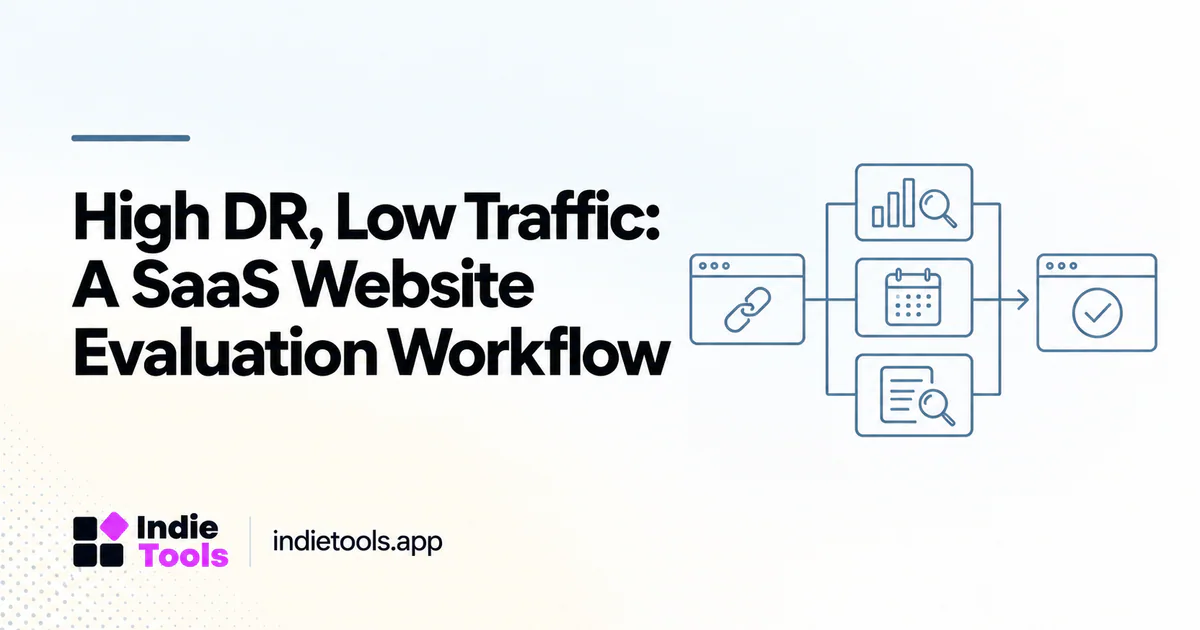
A high Domain Rating and low traffic can coexist because they describe different things. Before concluding that a website is underperforming, verify the traffic source, time period and business objective. Then examine whether the site's content matches the demand it is trying to attract.
DR summarizes backlink-profile strength; it does not count the website's customers. [1] A third-party traffic estimate is also not the same as first-party analytics. Keep those distinctions visible throughout the evaluation.
Verify what “low traffic” means
Identify whether the number comes from your own analytics, Search Console or an external estimate. Record the date range, geography, device and channel where relevant. Do not compare a monthly organic estimate with total visits from a different period.
For a niche B2B product, a small number of qualified visitors may matter more than a large general audience. Define the intended customer and useful action before deciding whether the observed volume is disappointing.
Inspect the pages that should earn demand
List the pages intended to answer buyer questions: product capabilities, integrations, comparisons, documentation and use-case guides. Ask whether each page provides enough information to complete its job.
A site may have relevant links to an old resource while its current product pages remain vague. A strong domain-level observation cannot compensate for a pricing page that hides essential information or a use-case page that says little beyond the product name.
Separate visibility from conversion
A visibility problem means the right people are not reaching the page. A conversion problem means visitors arrive but do not take the intended next step. Both can occur, but they need different investigations.
Review the actual queries and landing pages available in your authorized analytics tools. Without those records, keep the diagnosis provisional. Do not infer search demand from a keyword phrase merely because it sounds commercially valuable.
Review backlink relevance
Inspect representative linking pages rather than relying only on an aggregate number. Ask whether their audiences and topics are related to the product. An unrelated historical link profile may explain why the domain metric looks strong without providing an obvious path to current customers.
Avoid turning that observation into a recommendation to purchase more links. If you pay for promotion, treat it as advertising and follow the relevant link qualification requirements. Google recommends sponsored qualification for paid placements. [2]
Test a focused improvement
Choose one important buyer question and improve the page that should answer it. Add clear examples, limitations, supporting evidence and a relevant next step. Measure the page's observed performance rather than assuming that a longer article will solve the problem.
An illustrative experiment might improve an integration guide that already attracts relevant visitors but produces few completed setups. Better instructions and a working example may help more than another broad “best software” list. The decision follows the workflow evidence, not the domain score.
Use IndieTools for comparative discovery
IndieTools can help identify products and categories for a structured review. [3] Compare how peers describe their audience and demonstrate their workflow. Do not infer their private traffic or revenue from their public listing, DR or website polish.
Build a comparison sheet with “observed,” “provider-stated” and “unknown” fields. That prevents a research exercise from quietly becoming a set of invented business metrics.
Does high DR guarantee high search traffic? No. The metric alone cannot establish demand, relevance or conversion.
Can estimated traffic prove a competitor is failing? No. Estimates and incomplete public evidence do not justify that conclusion.
What is the first useful action? Identify one important page, verify its actual audience and examine where the visitor's task breaks down. That creates a testable improvement rather than a broad judgment based on two headline numbers.
Explore related IndieTools resources: Domain Rating leaderboard.
Continue your research
- Domain Rating and PageSpeed: A Two-Axis Review
- Directory Backlinks: Measure Referral Quality
- Domain Rating Benchmarks for Early-Stage SaaS
Sources and verification
Sources consulted for this article on October 1, 2026. Product capabilities are documented claims unless an actual test is explicitly described.