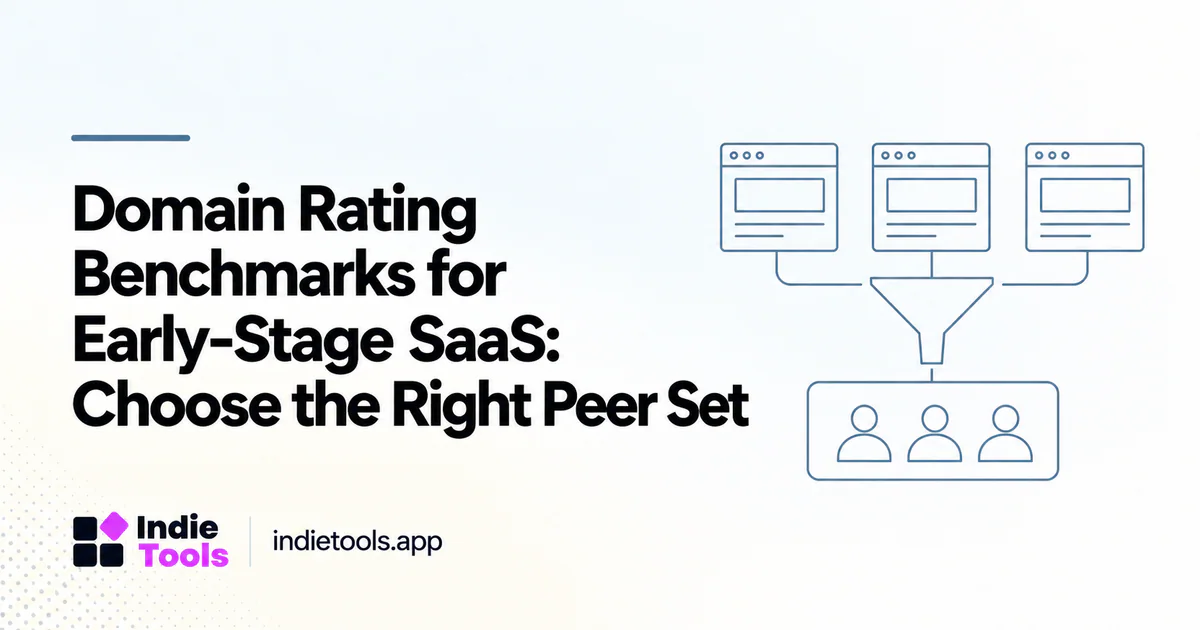
A useful Domain Rating benchmark compares your SaaS with a clearly defined group, not with whichever high-scoring websites happen to appear at the top of a leaderboard. Choose peers by product context and measurement scope before calculating a median or setting a target.
Ahrefs defines Domain Rating as a relative measure of backlink-profile strength. [1] It is not a complete description of a product's quality, customer traction or ability to solve a particular problem. A benchmark should therefore support a specific research question rather than become a general business score.
Define what “early-stage” means
Decide whether the group is based on product launch date, domain history, public revenue stage or another documented criterion. These are not interchangeable. A newly launched product can use an older domain, and a recently registered domain can belong to an experienced company.
When the necessary field is unavailable, say so. Do not infer product age from the date a directory listing was submitted. That date describes entry into the directory, not necessarily the start of the business.
Normalize the unit of analysis
Choose whether the dataset contains unique products or unique domains. Several products may share one domain, which would give that domain extra weight in a product-level average. Preserve both identifiers so readers can understand the distinction.
Also separate independent domains from marketplace pages and shared-hosting addresses. Record what was actually measured. A familiar product name attached to a platform URL does not establish that the score represents the product's own backlink profile.
Avoid the top-list trap
A leaderboard is selected by design. Its central value describes that selected population, not the entire software market. The IndieTools DR page identifies its current collection as a Top 100. [2] Treat that as a discovery surface unless you have a complete, validated export for the population your article claims to analyze.
A hypothetical example makes the problem clear: calculating the median of the strongest-scoring entrants cannot tell a new founder the median of all newly launched SaaS products. The arithmetic may be correct while the conclusion is wrong because the denominator changed.
Build an honest benchmark table
Include the cohort definition, observation date, eligible count, measured count and excluded count. Explain exclusions such as missing measurements or ambiguous domain ownership. Keep missing values distinct from a measured zero.
Use a median and distribution only after validating the observations. Show enough context to explain outliers, and avoid excessive precision when the sample is small. If the dataset is only a pilot, label it a pilot rather than presenting it as an industry standard.
Translate the benchmark into action
A lower score than a peer does not tell you which content to create or which relationships to build. Inspect the actual audience, referring pages and relevant resources. Ask what useful asset your product can contribute to its community: documentation, a reproducible benchmark, a focused calculator or a genuinely helpful integration guide.
Set goals around work you can evaluate directly, such as earning relevant mentions and attracting qualified visitors. Treat DR as one observation in the review, not the sole success condition. This keeps the benchmark from encouraging irrelevant submissions merely to move a number.
A practical founder worksheet
Write a one-sentence question, define the peer group, list the required fields and identify the missing ones. Collect a dated sample, validate domains and then decide whether the evidence is strong enough to publish a statistic. When it is not, publish the method or a narrower case analysis instead.
Is there one good DR for every startup? A universal target ignores differences in stage, market and domain history.
Can missing DR be treated as zero? No. Missing means the measurement is unavailable; zero is an observed value.
Where should IndieTools fit? Use its collections to discover candidate peers, then validate eligibility and measurements before calling the result a SaaS benchmark.
Explore related IndieTools resources: product categories.
Continue your research
- Can a DR 0 Product Compete in a Directory?
- High DR, Low Traffic: Evaluate a SaaS Website
- Build a Citation-Worthy SaaS Benchmark Dataset
Sources and verification
Sources consulted for this article on October 1, 2026. Product capabilities are documented claims unless an actual test is explicitly described.