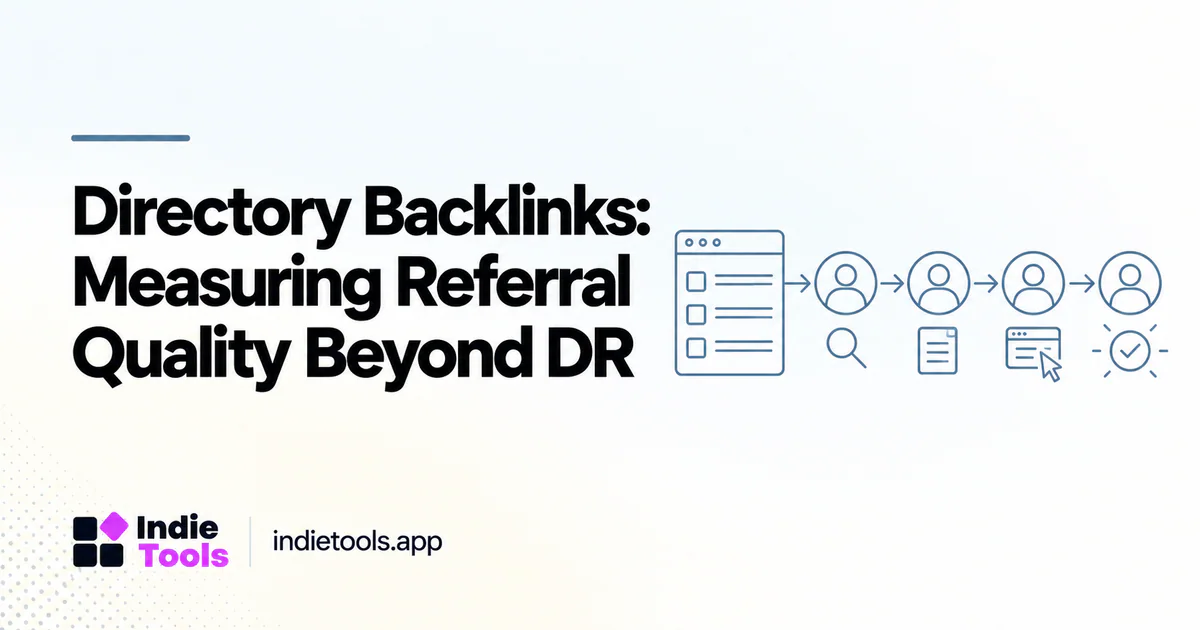
Measure a directory placement by the quality of the visitors and actions it produces, not only by the backlink associated with the listing. Define what a useful referral looks like before the placement goes live. Then separate discovery, evaluation, signup and activation in your reporting.
This approach does not require a large analytics stack. It requires consistent definitions and an honest account of what can and cannot be attributed.
Define a qualified visit
A qualified visit should reflect your product's audience and intended task. For an API service, it might involve reading an integration guide and creating a test key. For a design tool, it might involve opening a project and producing a first usable output.
Do not equate every page view with interest or every signup with value. Some visitors are other founders researching distribution; others may be outside the supported market. Define the action that demonstrates a plausible connection to the product's purpose.
Separate the discovery path
Record the placement, destination, date and campaign parameters where supported. Keep a distinction between visits to the directory's product page and visits to your own website. You may have access to one dataset without access to the other.
Use a short optional discovery-source question as supporting evidence, not as a perfect attribution system. People may remember several touchpoints or name the most recent one. Preserve that uncertainty rather than forcing every customer into a single-channel story.
Calculate useful rates carefully
For an observed cohort, calculate activation rate as activated referred signups divided by referred signups with a comparable opportunity to activate. Do not mix yesterday's new users with a month-old cohort when activation takes several days.
An illustrative result of three activated users from fifteen referred signups is twenty percent for that small observed cohort. It is not a stable forecast for the next campaign. Include the counts beside the percentage so the reader can see how much evidence supports it.
Account for time and placement cost
Include preparation, submission, creative work and maintenance when reviewing the experiment. A free listing can still require effort. A paid placement should have a defined format and duration so the cost can be compared with the observed outcome.
Do not treat paid ranking credit as the product being purchased. Google's link qualification guidance distinguishes advertising and sponsorship links from ordinary editorial references. [1] Evaluate promotion through its audience and results, not a guarantee of search visibility.
Read weak results constructively
Low activation may indicate poor audience fit, unclear positioning or a broken handoff. Inspect the landing page and first-use experience before concluding that all directory traffic is low quality. A promising audience can still encounter an irrelevant destination.
Conversely, a few successful users do not prove a scalable channel. Repeat a focused experiment when the evidence justifies it, and record what changed. Keep the comparison consistent enough to learn from the second attempt.
Apply the framework to IndieTools
IndieTools offers product discovery and distinct visibility options. [2] Choose the intended outcome for the specific option being used. A permanent product record, a time-limited placement and an editorial article serve different purposes and should not be collapsed into one traffic promise.
Keep your public product description accurate and your destination aligned with the listing. When a visitor clicks expecting one workflow and lands on a broad homepage with no explanation, the measurement problem begins before the analytics dashboard.
Is DR irrelevant? It can be a contextual backlink observation, but it does not replace referral and product-outcome data.
What if referrals are not fully attributable? Report the observable subset and its limitations.
What should a founder review after a month? The placement's actual cost, observed qualified visits, activation outcomes, user feedback and the next hypothesis. That is a more actionable result than a screenshot of a changed domain score.
Explore related IndieTools resources: Domain Rating leaderboard and product categories.
Continue your research
- Directory Submission ROI: Measure What You Know
- Featured Placement vs Organic Discovery
- Audit a Startup Directory Before Submitting
Sources and verification
Sources consulted for this article on October 1, 2026. Product capabilities are documented claims unless an actual test is explicitly described.