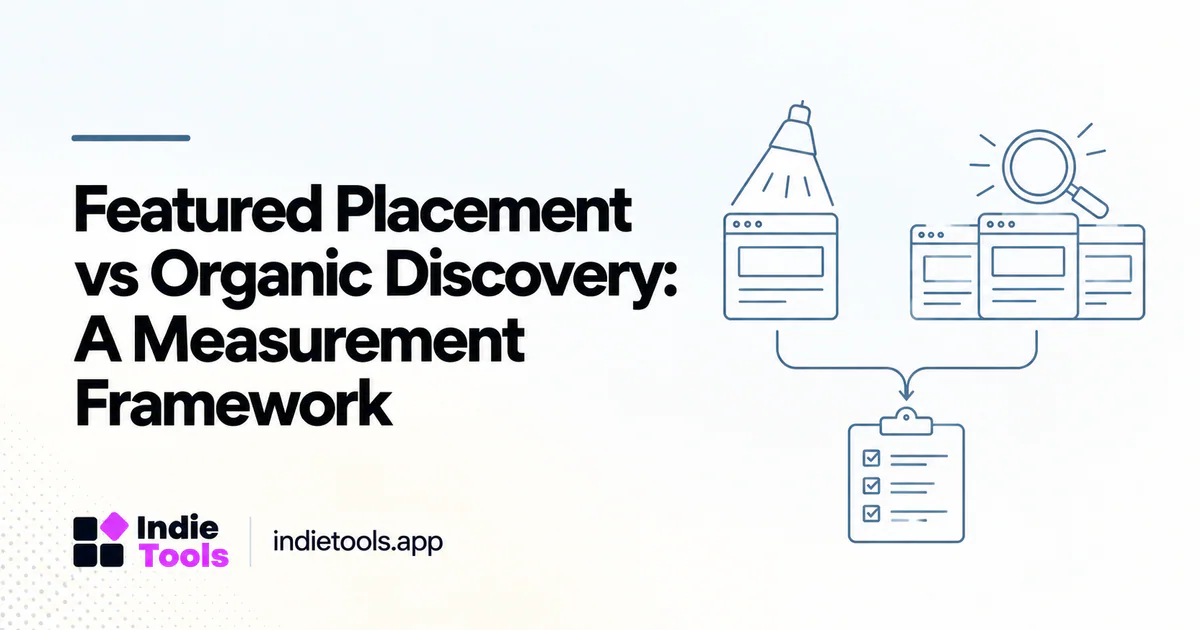
Featured placement and organic discovery should be measured as separate distribution mechanisms. A paid position changes where a product is shown within the purchased placement; it should not be described as proof that the product earned an organic ranking or became a better fit for every user.
For founders evaluating directory promotion, the key questions are what exposure was purchased, where the visitor lands and whether the resulting behavior supports the campaign's objective.
Identify the actual placement
Record the surface, duration, delivery conditions and destination. A homepage feature that opens a product profile differs from an advertisement that sends readers directly to a campaign page.
IndieTools' current pricing page distinguishes Featured visibility from advertising and states that paid placements do not change organic ranking. It also describes Featured visitors opening the IndieTools product page. [1] Verify current terms before purchasing because delivery details and availability can change.
Draw the full visitor path
For a Featured campaign, the path may include placement exposure, product-profile visit, outbound click and activity on the maker's site. Each step can lose information or use a different measurement definition.
Do not compare a directory's profile views directly with the maker's website sessions as though they were the same event. A visitor may read the profile without clicking out, and some outgoing visits may lack usable attribution. Preserve those differences in the report.
Establish a practical comparison period
Record the product's existing discovery before the placement begins, using a comparable reporting window where possible. Note other campaigns, releases or changes that occur during the test.
A before-and-after comparison is informative but not automatically causal. A major product release or holiday can affect both paid and organic activity. For a small campaign, a carefully documented descriptive result may be more defensible than claiming a precise incremental lift.
Define success beyond the click
Choose a useful downstream outcome such as a qualified trial, a completed setup or a relevant sales inquiry. A high click-through rate can coexist with weak product fit if the creative attracts curiosity without explaining the offering.
Review the product profile itself. Clear screenshots, accurate feature descriptions and an appropriate destination may matter more than changing the ad headline again. Paid discovery is a handoff, not an exemption from explaining the product well.
Disclose commercial context clearly
A paid position should be identifiable to readers. When a publisher includes paid outbound links, Google's guidance calls for appropriate link qualification and identifies rel="sponsored" for such relationships. [2]
Do not evaluate a placement solely by whether it passes ranking signals. The legitimate campaign objective is relevant exposure and measurable visitor behavior. Commercial disclosure and useful information can coexist without disguising the arrangement as an independent recommendation.
Decide whether to repeat the campaign
Compare the observed outcome with the full cost and available alternatives. Look at traffic quality, activation and support burden, not just a large impression number. Keep cash expenditure separate from modeled preparation time.
A useful conclusion may be to repeat the same placement, improve the product profile first or stop the experiment. Avoid extending the observation window indefinitely until the result appears positive. Preserve the original decision criteria and describe any later learning separately.
Frequently asked questions
Does Featured placement improve Google rankings?
A purchased directory position is not a guarantee of search ranking improvement. Evaluate the placement's own exposure and referral outcomes rather than promising an external search result.
Should Featured and advertising reports be combined?
Only with clearly separated components. Different destinations and delivery surfaces can produce different visitor paths, so retain the underlying metrics.
What does low outbound traffic mean?
Investigate profile clarity, audience fit and the destination before assuming the placement failed technically. A profile view is not necessarily a visitor who intended to leave the directory.
Explore related IndieTools resources: founder updates and releases.
Continue your research
- Run a Small Directory Advertising Experiment
- Directory Submission ROI: Measure What You Know
- Answer-First Software Comparisons with Evidence
Sources and verification
Sources consulted for this article on October 1, 2026. Product capabilities are documented claims unless an actual test is explicitly described.