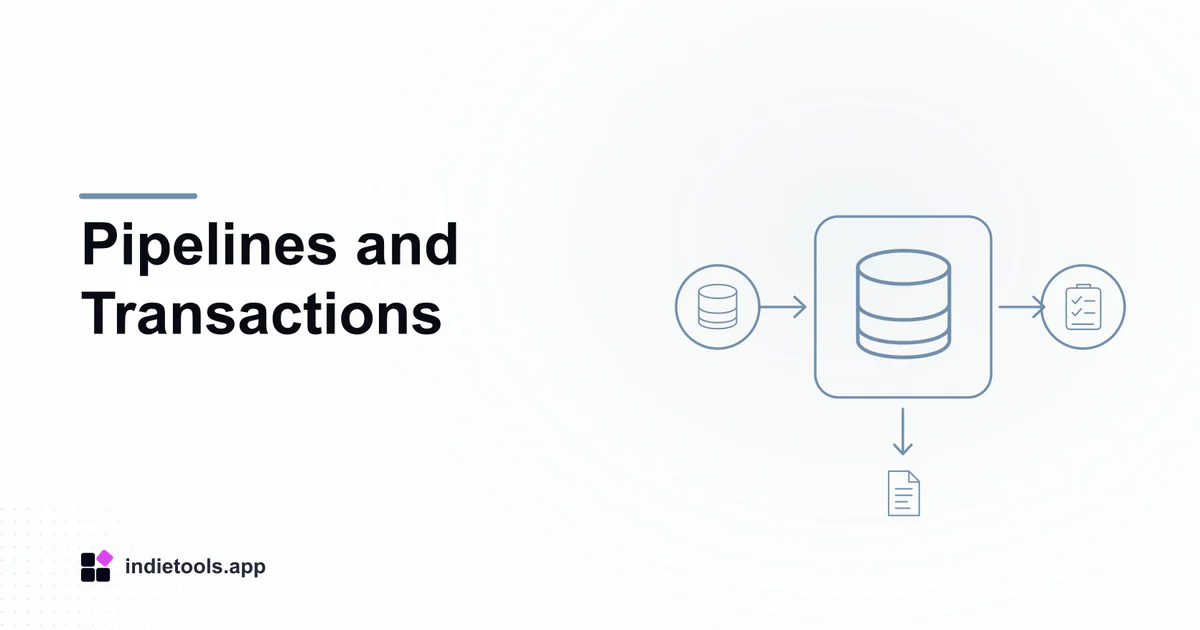
A pipeline reduces the number of network requests used to send Redis commands; a transaction addresses a different question about how a group of commands executes. Choose the mechanism from the application's correctness requirement first. A faster request pattern is not useful if overlapping work can produce an invalid result.
The Upstash Redis collection includes Orbit, a starter-kit example for developers exploring this stack. The review below concerns a hypothetical application built with these tools. It does not infer the starter's private command sequences from its catalogue entry.
Write the invariant before grouping commands
Consider a dashboard that reads several independent counters and a workflow that changes related values. The dashboard may tolerate a slightly different observation time for each counter. The mutation may require a relationship to remain true throughout concurrent activity.
Describe that relationship in plain language. Identify which datastore owns the authoritative record and which values are derived caches. Do not promote a convenient cached counter into the source of truth for a paid entitlement or durable business record without designing the corresponding guarantees.
This distinction often determines whether batching is enough or whether the operation needs a different atomic design.
Understand the SDK boundary
Upstash's pipeline and transaction documentation states that pipeline execution is not atomic and other commands can interleave. It presents transactions as the mechanism for atomic execution of their grouped commands.
That does not make every application-level workflow atomic. A transaction in Redis does not automatically include a database write, external API request or email sent elsewhere. Draw the full operation before deciding which part the Redis call protects.
Avoid describing a group of commands as a complete recovery strategy. Failure handling and the caller's knowledge of the outcome still need attention.
Keep responses attached to their commands
For a batched read, document the expected result position and type for every command. A later developer inserting a new command should not silently shift values into the wrong display fields.
Test missing keys, unexpected stored types and an empty input set. Preserve the difference between a legitimate zero, absent information and a failed request. Defaulting all three to the same dashboard value can conceal an operational problem.
Use named application results after decoding the batch so the rest of the interface does not need to remember positional details.
Test overlap and uncertain outcomes
Run concurrent calls against an isolated test datastore when a shared invariant is involved. Verify the final stored relationship as well as each caller's response. A sequential happy-path test cannot demonstrate the behaviour under overlap.
Simulate a response being lost after the server may have processed the request. Before retrying, ask whether repeating the command can apply the change twice. A read and an increment have different retry implications; treat them accordingly.
Keep any idempotency record in the same correctness design as the operation it protects. A separate best-effort flag can introduce another race rather than resolving the original one.
Measure the optimisation you actually made
After correctness checks pass, compare request count and latency under equivalent conditions. Record data size, region and concurrency. Do not turn a reduced request count into an unsupported universal speed claim.
For admission control, the Upstash timeout-policy guide covers what happens when a dependency cannot answer. Together, these reviews keep network efficiency, atomicity and failure behaviour visible as related but distinct engineering decisions.
 Stardew Valley Tracker
 IcyZip
 Xeramail Temp Mail