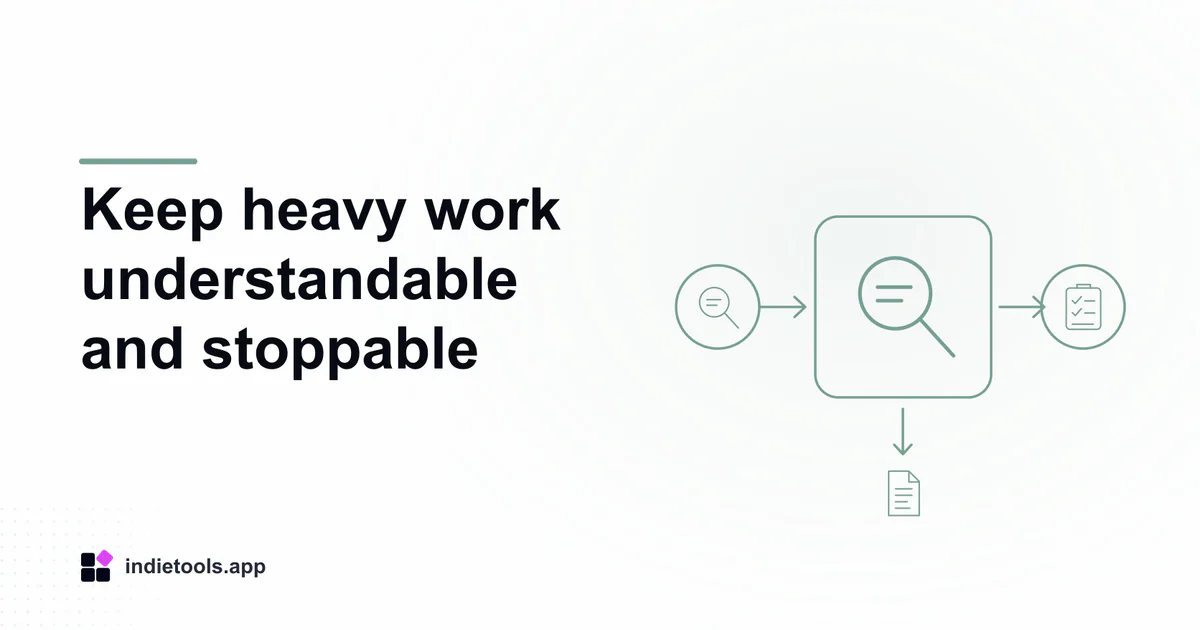
A heavy Node.js job needs more than a spinner. Users should know whether work was accepted, whether it is still progressing and what cancellation actually stops. Define those states before deciding which worker or queue arrangement to use.
The Node.js product collection provides examples of varied workloads. Kezio lists utilities including image-related tools, and Neyko FX describes a creative application panel. These descriptions were observed on October 3, 2026; they do not reveal either product's job infrastructure or imply measured performance findings.
Distinguish computation from waiting
Node.js worker-thread documentation distinguishes CPU-intensive JavaScript from I/O work that Node can already handle asynchronously. Moving every operation into a new worker is therefore not a substitute for understanding the task.
Describe a hypothetical processing job in stages: accept input, validate it, wait for an external service, transform the result and store the output. Mark which stages consume local CPU and which wait on another system. Use actual profiling in your own application before assigning a bottleneck.
The acceptance criteria can remain independent of the final implementation. A user should receive a stable job reference and a truthful status even if the team later changes its execution mechanism.
Put limits at the input boundary
Define supported dimensions, file sizes or item counts in terms meaningful to the user. Reject unsupported work before it consumes expensive processing whenever possible. A late failure after a long wait is a poor substitute for an actionable validation message.
For a proposed trial, include one ordinary input, one input at the documented boundary and one clearly invalid input. Do not use a live service for unbounded stress testing. Record whether the application explains the rejected condition and preserves any work the user can reuse.
Make cancellation a state transition
Ask what cancellation means at each stage. It may prevent a queued job from starting, stop local processing or simply stop waiting for an external operation that cannot be recalled. The interface should not promise reversal where only future work can be prevented.
Use a controlled test that cancels a harmless job and then refreshes its status. A disappearing spinner is not proof that computation stopped. Check whether the result is still stored, whether another process can continue it and whether the user can safely start a replacement.
If a provider request is already in flight, the product should explain the remaining uncertainty. That explanation is part of the workflow contract, not an implementation detail to hide from the person paying for the task.
Test retries without creating duplicate work
Propose a lost-response scenario: the job was accepted, but the browser did not receive confirmation. Retrying should follow a documented identity policy. The user needs a way to recover the original job rather than submit several expensive copies unknowingly.
Keep the evaluation record specific: input, accepted identifier, observed transitions, cancellation outcome and retained result. Do not infer throughput from one run or compare unrelated tools by a framework label.
For products that span a desktop host and remote services, begin with the Node.js runtime boundary review before attributing a stalled interface to a particular process.

 IcyZip
 code.live
 Xeramail Temp Mail
 Stardew Valley Tracker