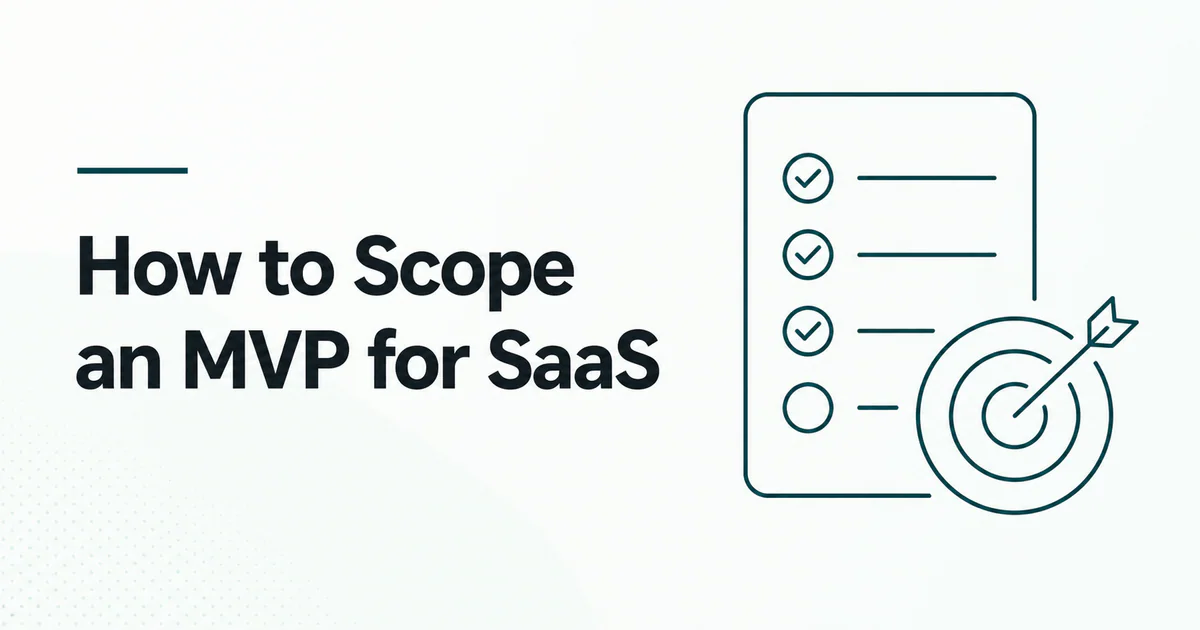
Quick answer: Scope a SaaS MVP by choosing one narrow customer, one recurring problem, one complete success path and one learning goal. Include only the features required to let that customer reach the promised outcome safely. Defer breadth, automation and polish that do not change the test.
An MVP is not a smaller version of your full roadmap. It is a deliberate experiment delivered as a usable product. If the initial release cannot tell you whether users reach value, return and pay, its scope may be small but it is not strategically minimal.
Start with SaaS idea validation if you do not yet have evidence of the problem.
Write an MVP scope sentence
Use this template:
For [specific customer] experiencing [specific trigger/problem], the MVP helps them achieve [measurable outcome] through [one core workflow]. We will learn whether [riskiest assumption] by measuring [behavior] over [period].
Example:
For small SEO agencies preparing weekly client reports, the MVP turns analytics exports into a branded summary through one upload-and-review workflow. We will learn whether agencies repeat the workflow and pay to save preparation time during a four-week pilot.
This sentence becomes a filter. A feature belongs only if removing it prevents the target user from completing the workflow, makes the test unsafe or blocks measurement.
Map the single success path
Write the shortest end-to-end journey:
- User arrives with the expected problem.
- User understands the promise.
- User creates or accesses an account if necessary.
- User provides the minimum input.
- The product performs its core transformation.
- User reviews, exports or uses the result.
- The product records whether value occurred.
- User can pay, request help or leave feedback.
This “happy path” should work reliably before you add additional roles, templates or integrations. It also exposes missing operational features: a product may need error recovery and support before it needs a dashboard.
Sort features into five buckets
| Bucket | Definition | Example |
|---|---|---|
| Core value | Creates the promised outcome | Generate the weekly report |
| Required access | Enables safe use | Sign-in and basic authorization |
| Required operations | Lets you deliver and support | Error logs and a support contact |
| Required learning | Measures the thesis | Activation and repeat-use events |
| Later | Expands convenience or market | Teams, themes, API, many integrations |
“Required” depends on context. A medical workflow has different security and audit obligations from a public image tool. Minimum never means ignoring legal, security, accessibility or data-protection responsibilities.
Use the test of subtraction
For every proposed feature, ask:
- Which customer action becomes impossible without it?
- Which assumption will it test?
- Could we perform this step manually for the first ten users?
- Is this needed before the first value moment or after it?
- Does it support the chosen segment or an imagined future segment?
- What ongoing maintenance does it create?
If the answer is “it makes the product feel complete,” move it to later. Completeness is not an early learning objective.
Choose manual work deliberately
Manual operations are acceptable when they preserve a credible customer experience and accelerate learning. You might approve accounts manually, transform data behind the scenes or create reports by hand. Document the process so you can see what deserves automation.
Do not hide material manual work from customers if it affects privacy, timing or expectations. A concierge MVP should still make an honest promise.
Decide what to buy, borrow or build
Solo founders should rarely build undifferentiated infrastructure first. Compare:
- authentication and authorization;
- subscription billing;
- transactional email;
- storage and backups;
- analytics and error monitoring;
- support and feedback collection.
A SaaS boilerplate may accelerate conventional flows. The solo SaaS tech stack guide explains how to keep the number of operational systems manageable.
Build the part where your product creates differentiated value. Buy or use managed services for commodity components when their constraints fit.
Define release gates
A useful MVP definition includes quality gates, not just a feature list:
Functional gate
The success path works with realistic data, including expected empty and error states.
Trust gate
The page explains what the product does, who operates it, how data is handled and how users can get help. Billing and cancellation terms are understandable.
Operational gate
You can see errors, restore essential data, respond to a support request and disable a broken workflow.
Learning gate
You can identify qualified sign-ups, activation, repeat value and paid conversion. Do not collect events merely because a tool offers them.
Launch gate
You have a small, reachable set of intended users and a plan to onboard them personally. A directory launch can follow; first ensure the workflow survives real use. See the SaaS launch checklist.
Measure the MVP, not vanity
Choose one metric at each stage:
| Stage | Useful question | Example measure |
|---|---|---|
| Acquisition | Did the right people arrive? | Qualified visitors or conversations |
| Activation | Did they experience value? | Completed core workflow |
| Retention | Did the problem recur? | Repeated workflow in the expected period |
| Revenue | Will they pay? | Paid pilots, subscriptions or expansion |
| Learning | Why did behavior occur? | Interview themes tied to event data |
For a monthly tax tool, day-seven retention may be meaningless. Match the observation window to the natural frequency of the problem.
A practical two-page MVP brief
Page one: strategy
- Target customer and trigger
- Current alternative
- Promised outcome
- Riskiest assumption
- Success behavior and review date
Page two: delivery
- One success-path diagram
- Included features
- Explicitly excluded features
- Manual operations
- Trust and quality gates
- Launch group and feedback process
This is often more useful than a long requirements document because it preserves the reason behind the scope.
Common scope traps
Multi-segment MVP
Building for freelancers, agencies and enterprises produces conflicting permissions, onboarding and pricing. Pick the segment with the clearest pain and access.
Integration-first MVP
Every integration adds authentication, error modes and support. Begin with upload, copy-paste or one high-signal integration unless connectivity is the product's core value.
Settings-first MVP
Configuration feels safe to build because it avoids choosing a default. Good MVPs make informed defaults and add settings after real differences appear.
“Scalable” before observable
Design for basic data integrity and a plausible migration path, but do not optimize for traffic you cannot yet acquire. Reliability for ten real users matters more than theoretical capacity for a million.
Frequently asked questions
How long should a SaaS MVP take to build?
There is no universal duration, but a narrow MVP is generally measured in weeks rather than many months. If the scope cannot fit a short cycle, reduce the segment, workflow or automation before reducing safety.
Should an MVP include payments?
Include a way to test willingness to pay when revenue is a core assumption. That can be a normal checkout, invoice or paid pilot. Do not build elaborate packaging before you understand value.
Does an MVP need authentication?
Only if accounts, private data, saved state or paid access require it. A public calculator or generator may validate value without accounts.
What comes after the MVP?
Review behavior and interviews. Keep, revise or remove the tested workflow; improve activation and reliability; then add features that serve validated demand. A roadmap should follow evidence, not restore the original wish list.
 LaunchLog
 FoundrList
 Pushable AI
 99helpers
 Niches Hunter
 Email SDK