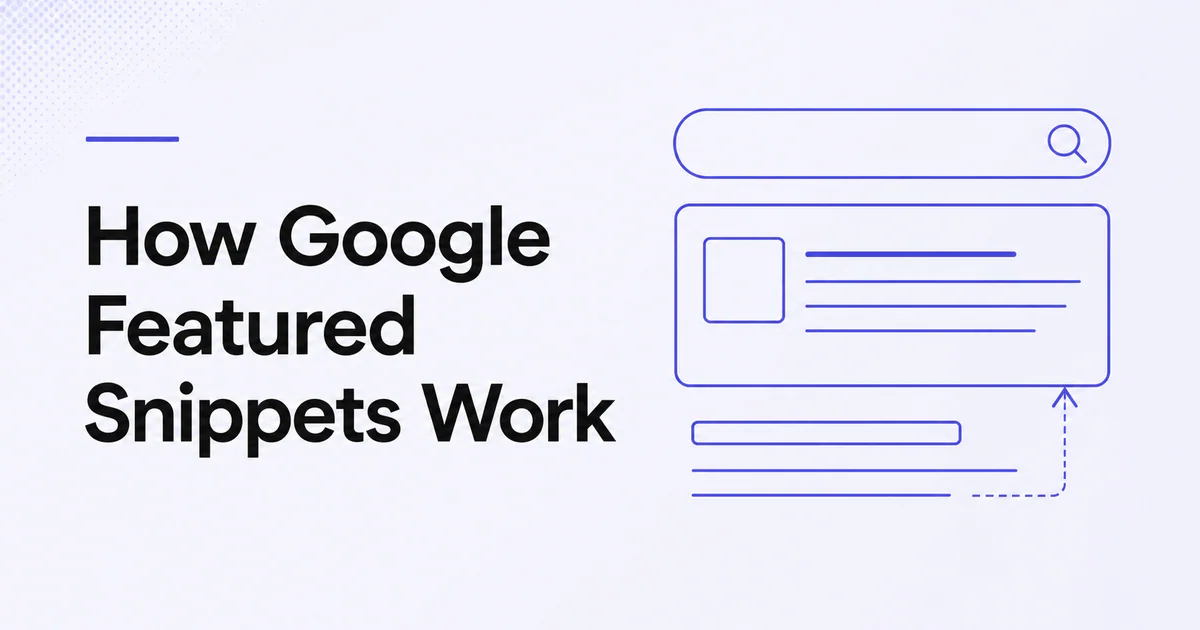
Quick answer: Google featured snippets are automatically selected excerpts that give users a descriptive answer from a web result. Publishers cannot mark a page as a featured snippet or guarantee selection. They can make content clear and eligible, and they can limit or prevent excerpts with controls such as nosnippet, max-snippet and data-nosnippet.
Featured snippets can appear before standard results or inside related-question experiences. They normally include information taken from a page plus a link to that source. The presentation and availability can vary by query, device, location and time.
How does Google choose a featured snippet?
Google's systems decide whether a page would make a useful featured snippet for a particular request. There is no special “featured snippet schema” and no manual tag that asks Google to select a passage.
The process is query-dependent. A page can receive a snippet for one question and appear as an ordinary result for another. Selection may change when Google's systems find a passage that better answers the request or when the result set changes.
The practical goal is therefore not to “claim position zero.” It is to create an eligible, relevant result containing a concise passage that accurately answers the query and is supported by the rest of the page.
Common featured snippet formats
| Format | Best suited to | Example structure |
|---|---|---|
| Paragraph | Definitions and concise explanations | Direct answer followed by context |
| Ordered list | Processes, rankings or recipes | Numbered steps in real sequence |
| Unordered list | Sets of options, features or examples | Bullets with parallel phrasing |
| Table | Consistent comparisons or compact data | Descriptive headers and aligned values |
| Video | Demonstrations and visual instructions | Relevant segment and clear context |
Google controls the final layout and may transform or combine material. Adding a table does not guarantee a table snippet, and numbering headings does not guarantee a list snippet.
How to make a page snippet-ready
- Identify the exact question and its intent.
- Use the question or a close natural variant in a descriptive heading.
- Answer immediately in the format the question requires.
- Define important terms and units.
- Support the concise answer with deeper evidence.
- Keep the page crawlable and eligible for snippets.
- Use a clear title, H1 and internal links.
- Review the result and update outdated facts.
This checklist improves clarity and eligibility; it cannot guarantee that Google displays the page as a featured snippet.
1. Match the real search intent
A query beginning with “what is” often needs a definition. “How to” usually needs a sequence. “X vs Y” often benefits from consistent comparison criteria. The format should follow the user task instead of a preferred SEO template.
For example:
- “What is Domain Rating?” needs a concise definition and an explanation of what the metric does not mean.
- “How to increase Domain Rating” needs ordered, ethical link-earning actions.
- “Domain Rating vs Domain Authority” needs a table with provider, inputs and interpretation.
Start with the search intent guide if the query could mean several different things.
2. Write the short answer first
Place a complete answer close to the relevant heading. It should make sense without relying on “this,” “it” or an unexplained phrase from the previous paragraph.
A useful definition usually contains:
- the full name of the subject;
- its category or purpose;
- the essential mechanism;
- a boundary or limitation when readers commonly misunderstand it.
Do not pad the answer to hit a fixed length. Google can choose different excerpts, and clarity matters more than a word-count myth.
3. Use genuine list and table structure
If the answer is a process, use an ordered list and put steps in the actual sequence. If it is a set without priority, use bullets. If it compares several items across the same criteria, use a table.
Tables should have descriptive headers, consistent units and enough nearby context to prevent misinterpretation. Do not put long unrelated paragraphs inside cells merely to force a table format.
Semantic HTML and readable page structure help users and machines understand the relationship among items. Still, the format must serve the answer rather than function as decoration.
4. Add depth below the excerpt
A snippet-ready answer should not turn the page into thin content. Explain evidence, examples, exceptions and the next action below the concise passage.
For a metric such as Domain Rating, readers also need to know:
- who produces the metric;
- how its logarithmic scale behaves;
- how it differs from page-level metrics;
- why it is not a Google ranking factor;
- how to compare it within a relevant market.
This supporting depth makes the page useful even when no snippet appears. Review what SEO is and the on-page SEO checklist for the broader content foundation.
5. Keep the page technically eligible
A page generally needs to be accessible and eligible as a Google result before it can provide a featured snippet. Check response status, robots directives, canonicalization, rendering and internal discovery.
Use normal crawlable <a href> links to connect relevant pages. Keep important answers in the page's primary content rather than requiring an interaction that search systems may not process as expected. The technical SEO checklist provides a systematic review.
Featured snippet controls
Google gives site owners several controls over excerpts:
| Control | Effect |
|---|---|
nosnippet |
Prevents a text snippet from being shown for the page |
max-snippet:[number] |
Sets a maximum text-snippet length in characters |
data-nosnippet |
Excludes selected HTML content from snippets |
These controls can affect more than featured snippets, so use them carefully. Google's documentation notes that a sufficiently low max-snippet value can prevent content from appearing as a featured snippet. The exact minimum length needed can vary by language and result.
Do not use snippet controls as a method to select your preferred paragraph; they are limiting controls, not nomination tools.
Featured snippets vs other search features
| Feature | What it is | How publishers influence it |
|---|---|---|
| Featured snippet | Automatically selected descriptive excerpt from a result | Eligibility, relevance, clear answer and snippet controls |
| Search-result snippet | Title/link result's descriptive text | Page content, meta description and snippet controls; Google may choose text |
| Rich result | Enhanced result supported by eligible structured data | Valid supported markup and policy compliance |
| AI Overview | Generative summary that can include supporting links | Core SEO eligibility and quality; no special AI markup required |
People sometimes call all enhanced results “rich snippets,” but the mechanisms differ. Adding FAQ structured data does not nominate a page for a featured snippet. A meta description can inform the normal result description, yet Google may generate a different excerpt from page content when it better matches the query.
How to track featured snippets
Google Search Console can show queries, impressions, clicks, pages and average position, but it does not provide a universal featured-snippet filter for every report. Combine its data with manual SERP checks or a reputable rank tracker.
When monitoring, record:
- query;
- country and device;
- date and time;
- snippet source URL;
- format;
- competing source;
- impressions and clicks around the change.
Do not infer business value from ownership alone. A snippet may increase visibility, reduce clicks by satisfying the question directly or drive highly qualified visits. Measure the effect on the landing page and conversion path.
Why a featured snippet can disappear
A snippet can change because:
- another page supplies a more useful passage;
- the query interpretation changes;
- your content becomes outdated;
- the page loses index or snippet eligibility;
- a robots or canonical change affects the URL;
- Google changes the result layout;
- user context produces a different result.
First verify technical eligibility and whether the page still answers the current intent. Do not react by stuffing the query into every heading or copying the competing excerpt.
Featured snippet mistakes
- promising “position zero” as a guaranteed outcome;
- creating thin pages for near-identical questions;
- forcing every answer into 40 or 50 words;
- adding an unnecessary table;
- using heading fragments that do not read naturally;
- publishing unsupported facts in the opening answer;
- assuming FAQ schema creates a featured snippet;
- blocking snippets accidentally;
- ignoring changes in query intent;
- measuring visibility without clicks or outcomes.
The strongest snippet candidate is first a strong search result: technically eligible, clearly relevant, accurate and worth reading beyond the excerpt.
Frequently asked questions
Can I add schema for a featured snippet?
No special structured data marks a page as a featured snippet. Google chooses featured snippets automatically.
Is a featured snippet always the first result?
It is a prominent descriptive result and may appear before standard results or within related-question experiences. Search layouts vary, so “position zero” is an informal and incomplete label.
Can I opt out of featured snippets?
Yes. Google documents nosnippet, max-snippet and data-nosnippet controls. They can also affect other result snippets, so assess the broader impact first.
Does a meta description become the featured snippet?
Not necessarily. Google can select page content that it considers a better answer to the query.
Are featured snippets the same as AI Overviews?
No. A featured snippet is a descriptive excerpt attributed to a result. An AI Overview is a generated response that can synthesize information and show supporting links.

 Preflight.sh
 SEOReport