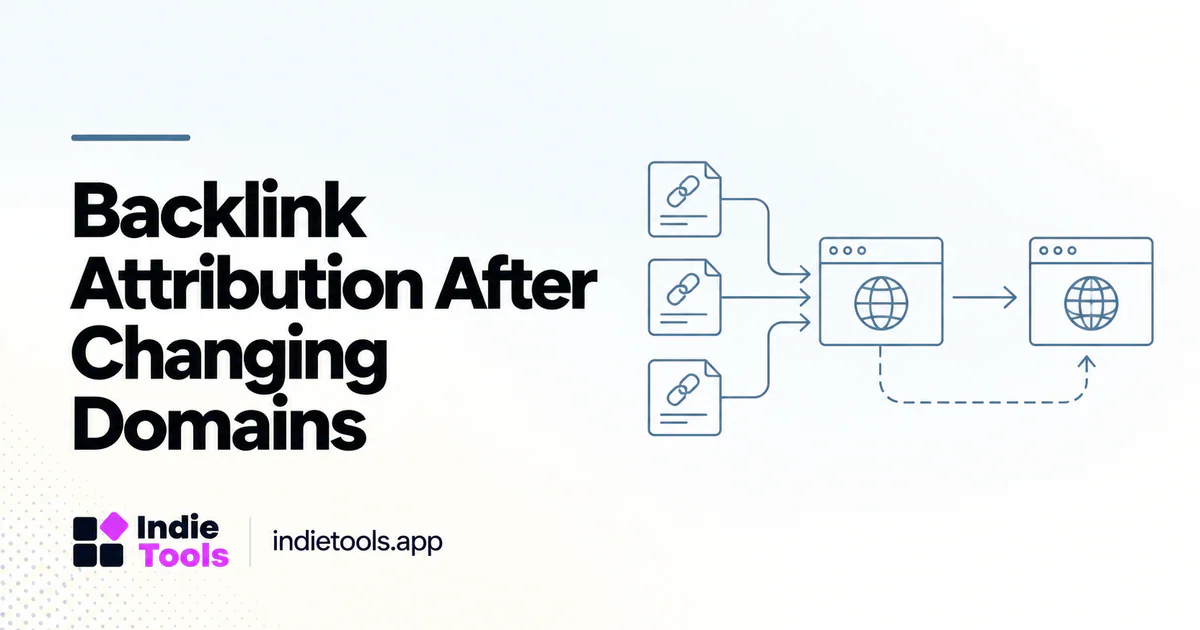
After a domain change, distinguish links that still point to the old domain, links updated to the new domain and visits that arrive through redirects. These are related records, but they are not the same measurement. A clean migration report preserves each path instead of combining everything into a single unexplained total.
Google's site-move documentation recommends a deliberate old-to-new URL mapping. [1] That mapping is also the foundation for understanding how historical mentions continue to lead people to the product.
Create an identity map
Record the old brand, old domain, new brand and new domain, including the effective dates. Map important product and content URLs individually. Preserve cases where a feature was retired or several pages were consolidated into a genuinely relevant destination.
Do not assume every mention of the old name refers to the same product. Acquisitions, similarly named companies and reused domains can complicate entity matching. Keep ambiguous records separate until they can be checked.
Classify incoming references
Group observed references into old-domain links, new-domain links and platform listings that need correction. Record the source page, destination and date checked. Where available, distinguish a link discovered by a backlink provider from a visit recorded in first-party analytics.
A discovered backlink does not prove that someone clicked it. A referral visit may arrive without a complete campaign label. The report should explain these limitations rather than treating either dataset as a complete account of the customer journey.
Verify the redirected experience
Open representative old links and confirm that they reach a useful new page. Check redirect chains, errors and lost context. An old integration guide should not automatically lead to a generic homepage if an equivalent guide exists.
Test campaign parameters deliberately. Preserve the parameters needed for your own analysis when appropriate, but avoid carrying sensitive or meaningless values into public URLs. Document the policy so engineering and marketing interpret the same journey consistently.
Keep authority histories separate
If you track a domain-level metric, store old-domain and new-domain observations as separate series. Do not present them as one uninterrupted growth curve. A domain change is a measurement boundary, even when the product and customers continue.
A hypothetical report might show old-domain references gradually declining as publishers update their pages while new-domain references grow. That is a migration pattern to investigate, not proof that all search signals transferred on a specific date or in a predictable amount.
Update high-value public records
Prioritize product listings, documentation links, partner pages and profiles that real customers use. Contact relevant owners with the correct new destination and a concise explanation. Avoid mass outreach that treats every historical mention as equally valuable.
Review the IndieTools product record as part of this process. Its technology and category collections lead visitors to product identities, so an accurate canonical destination helps preserve a coherent discovery path. [2] Do not create duplicate records merely to retain both old and new brand names.
Report progress without false precision
Show how many reviewed references were updated, how many still redirect successfully and how many are broken or unresolved. State the size and source of the reviewed set. Unless the inventory is demonstrably complete, call it a reviewed sample rather than “all backlinks.”
Add observed referral outcomes where available, but do not attribute every post-migration signup to the update work. Other campaigns, product changes and seasonal effects may have occurred at the same time.
Does a redirect mean a referring site updated its link? No. The source still points to the old destination until it is changed.
Can a new domain's score be compared directly with the old one? The scopes differ; preserve that distinction.
What makes a useful migration report? A dated identity map, verified destinations, explicit measurement boundaries and a prioritized correction list. Those records help both users and future analysts understand what changed.
Explore related IndieTools resources: Domain Rating leaderboard.
Continue your research
- Test Website Speed After a Domain Migration
- AI Search Brand Confusion After a SaaS Rebrand
- Domain Rating History: Read Weekly Changes
Sources and verification
Sources consulted for this article on October 1, 2026. Product capabilities are documented claims unless an actual test is explicitly described.