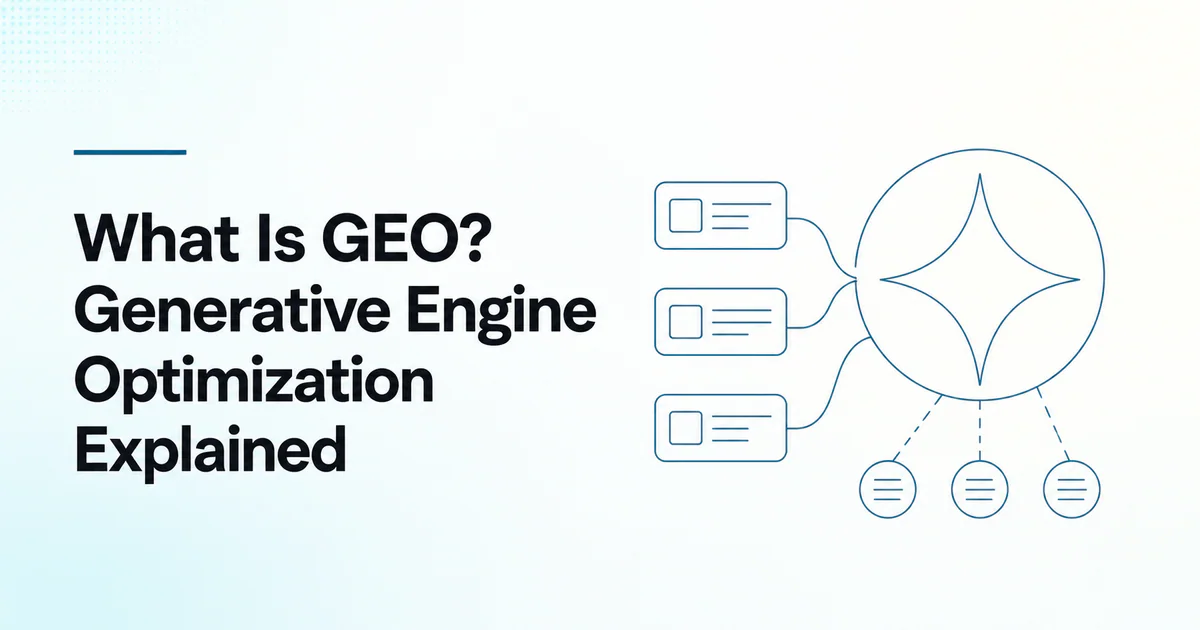
Quick answer: GEO, or Generative Engine Optimization, is the practice of making web content easier for AI-powered search and answer systems to discover, retrieve, understand and cite. It builds on SEO fundamentals such as crawlability, relevance and quality, then emphasizes clear answers, sourceable evidence, entities, freshness and citation measurement. GEO cannot guarantee inclusion in AI answers.
The term became prominent through the 2024 “GEO: Generative Engine Optimization” research, which studied ways to improve source visibility inside generative responses. The field has evolved quickly and evidence remains platform-dependent.
How GEO works
A simplified AI-search pipeline can include:
- user asks a question;
- system reformulates or expands the query;
- search or retrieval selects candidate sources;
- sources are reranked or filtered;
- a model synthesizes an answer;
- citations or links are attached;
- the user may continue with follow-up questions.
GEO can influence several stages, but publishers do not control the complete pipeline.
GEO vs traditional SEO
| SEO | GEO |
|---|---|
| Targets search discovery and ranked results | Targets discovery, citation and use in AI answers |
| Measures impressions, clicks and positions | Measures mentions, citations, cited pages and referral visits |
| Optimizes pages and sites | Often optimizes passages, evidence and entity clarity too |
| Relies on crawl and index eligibility | Usually still relies on search/retrieval eligibility |
| Mature tooling and guidance | Emerging, variable measurement |
Google says optimizing for its generative Search features is still SEO because AI Overviews and AI Mode use core Search ranking and quality systems.
Read SEO vs GEO for the detailed comparison.
Is GEO a replacement for SEO?
No. A source normally needs to be accessible and discoverable before a retrieval system can cite it.
Foundational requirements remain:
- crawlable URLs;
- indexable content;
- useful main content;
- logical site structure;
- clear authorship and provenance;
- reliable hosting;
- relevant links and mentions;
- accurate facts.
Read what is SEO and the technical SEO checklist.
What Google says about GEO
Google’s 2026 AI optimization guide acknowledges AEO and GEO as common industry terms. From Google Search’s perspective, the work remains part of SEO.
Google specifically advises publishers to:
- create valuable, non-commodity content;
- keep strong technical SEO foundations;
- use normal supported structured data accurately;
- maintain product and business information;
- measure generative-search visibility in Search Console.
It says publishers do not need llms.txt, special AI markup or artificial “chunking” to appear in Google generative Search.
GEO outside Google
Different platforms have different crawlers, retrieval indexes and citation policies.
Examples include:
- Microsoft Copilot and Bing generative answers;
- ChatGPT search;
- Perplexity;
- other AI assistants with web retrieval.
OpenAI advises publishers who want ChatGPT search discovery not to block OAI-SearchBot. Microsoft’s Bing Webmaster Tools introduced AI Performance reporting in 2026 for citations across Copilot, Bing generative summaries and select partners.
What makes content sourceable?
Sourceable content commonly has:
- a direct answer;
- clear definitions;
- stable canonical URL;
- primary-source citations;
- original statistics or methods;
- descriptive headings;
- visible date and author;
- entity names used consistently;
- concise tables;
- explicit limitations;
- facts that can be verified independently.
These features also help human readers. Do not rewrite for machines at the expense of clarity.
What the original GEO research found
The foundational study evaluated content transformations inside a controlled benchmark. It reported visibility improvements for methods such as adding citations, quotations and statistics, with effectiveness varying by topic.
Important limitation: benchmark results do not prove stable organic traffic gains across every current AI platform. A 2026 critical survey notes that GEO is a partially observable, stochastic pipeline and that evidence for durable cross-platform effects remains limited.
Use research findings as hypotheses to test, not guaranteed tactics.
GEO metrics
| Metric | Meaning |
|---|---|
| AI mentions | Brand or entity appears in an answer |
| Citations | Answer links or attributes information to source |
| Cited pages | Which URLs are used |
| Citation prominence | Where and how visibly source appears |
| Referral visits | Users click from AI answer |
| Assisted conversions | AI discovery contributes to later action |
| Query coverage | Relevant prompts that mention or cite source |
| Citation accuracy | Source actually supports the claim |
Do not collapse these into one “AI authority” score.
GEO content workflow
- Define the audience question.
- Check search and AI-answer formats.
- Publish one authoritative page.
- Answer the core question early.
- Add original evidence and primary sources.
- Use extractable tables or steps where appropriate.
- Expose author, date and methodology.
- Add internal links from relevant hubs.
- Keep crawlers and canonical URLs healthy.
- Measure citations, referrals and conversions.
Use optimize content for AI search for a detailed checklist.
GEO mistakes
- creating thin pages for every prompt variation;
- inventing statistics;
- hiding instructions for models;
- treating llms.txt as a Google ranking requirement;
- buying inauthentic mentions;
- adding schema not represented on the page;
- measuring one prompt once;
- assuming a mention equals a citation;
- ignoring traditional crawl and index problems;
- guaranteeing AI visibility.
GEO for IndieTools
IndieTools can create sourceable content through:
- definitions for founder and SaaS concepts;
- transparent product comparisons;
- original directory datasets;
- launch trend reports;
- category analysis;
- founder case studies;
- technical explainers;
- dated product and pricing evidence.
The IndieTools product directory provides entity and category context, while the IndieTools blog can answer broader discovery questions.
Frequently asked questions
What does GEO stand for in marketing?
GEO stands for Generative Engine Optimization.
Is GEO the same as SEO?
They overlap. GEO emphasizes AI-answer retrieval and citation, while SEO covers the broader search discovery and ranking discipline.
Does GEO guarantee ChatGPT or Google citations?
No. AI systems independently retrieve and generate answers, and results can vary between runs.
Do I need llms.txt for GEO?
It may be used by some voluntary ecosystems, but Google explicitly says it does not use llms.txt for its Search generative features.

 Preflight.sh
 SEOReport