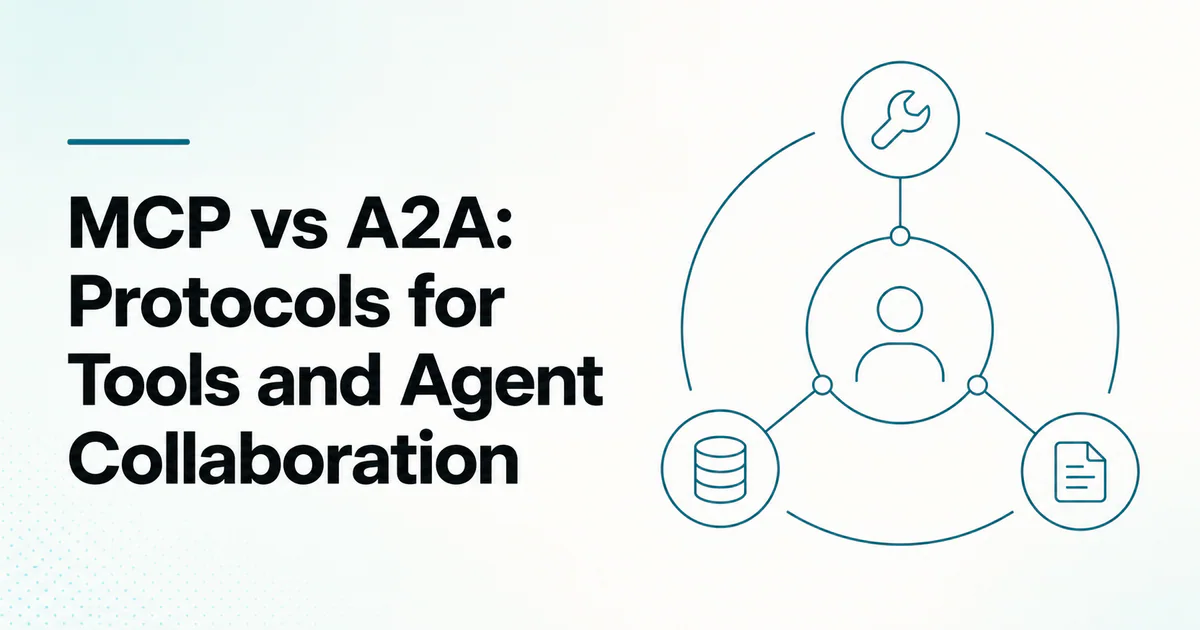
Quick answer: MCP connects an AI application to tools, resources and prompts exposed by servers. A2A connects independent agent systems so they can discover capabilities, delegate work and exchange task updates or artifacts. Use MCP when an agent needs access to a system; use A2A when one autonomous service needs another agent to own part of the work. They are complementary, not direct replacements.
The confusion is understandable: both protocols support agentic applications, both use client-server ideas and both can sit between independently maintained systems. Their boundaries are different. MCP standardizes capability access inside an AI host; A2A standardizes collaboration with a remote agent whose internal implementation can remain opaque.
MCP vs A2A at a glance
| Dimension | MCP | A2A |
|---|---|---|
| Full name | Model Context Protocol | Agent2Agent Protocol |
| Primary connection | AI host to tools and data | Agent/client to remote agent |
| Remote party exposes | Tools, resources and prompts | Agent capabilities and task interface |
| Unit of interaction | Capability discovery and invocation | Message, task, status update and artifact |
| Ownership of reasoning | Host coordinates model and tools | Remote agent can own its internal workflow |
| Discovery mechanism | Server capabilities and registry metadata | Agent Card and capability metadata |
| Best fit | System integration | Cross-agent delegation and collaboration |
| Can use the other? | MCP-backed agent can be exposed through A2A | A2A agent can use MCP tools internally |
What MCP does
MCP defines a protocol between a host application, its MCP clients and capability servers. The host may connect to several servers and creates a dedicated client connection for each.
Servers can expose:
- tools for queries and actions;
- resources for readable context;
- prompts for reusable workflow templates.
For example, a coding agent can use a Git provider's MCP server to search issues. The MCP server remains an integration surface; the host agent decides why and when to use the tool.
Read what is Model Context Protocol and how MCP works for the full architecture.
What A2A does
A2A is an open protocol for communication and interoperability between independent agentic systems. An A2A server publishes an Agent Card describing identity, endpoint, capabilities, skills and supported interaction modes. A client can then send messages, create or continue tasks, receive status updates and obtain artifacts.
The remote agent can remain opaque. It may use its own model, memory, planner, policies and tools. The caller asks for an outcome or skill instead of invoking every low-level function directly.
An example is a procurement agent delegating a vendor-risk review to a specialized compliance agent. The compliance agent manages its own research workflow and returns a report artifact with task status.
The core distinction: capability invocation vs work delegation
Suppose a launch manager must assess a release.
With MCP, the manager agent might call:
list_open_issues;get_deployment_status;search_product_docs;create_release_task.
The manager owns the loop and combines low-level results.
With A2A, the manager might delegate “perform the security readiness review” to a security agent. That remote agent selects its own tools, works through multiple steps and returns a risk report.
This resembles the difference between tools and agent delegation in multi-agent architecture. Read single-agent vs multi-agent systems before introducing another independent agent.
Discovery and interface design
MCP discovery
An MCP connection negotiates capabilities. The host can list tools, resources and prompts. Tool definitions include names, descriptions and schemas that make individual operations callable.
A2A discovery
An A2A Agent Card describes the agent's capabilities and connection information. The interface is outcome-oriented: the caller learns what the agent can do without needing its internal tools or prompt design.
Both require precise descriptions. Poor MCP tool descriptions cause incorrect tool selection. Poor A2A skill descriptions cause bad delegation or unrealistic expectations.
Interaction lifecycle
Typical MCP lifecycle
- Host creates an MCP client connection.
- Client and server initialize and negotiate capabilities.
- Host lists or filters available tools.
- Model selects a tool.
- Policy or user approval is applied.
- Client calls the server.
- Structured result returns to the host.
- Agent continues or finishes.
Typical A2A lifecycle
- Client discovers and validates the remote Agent Card.
- Client sends a message or creates work.
- Remote agent accepts, rejects or requests more input.
- Task moves through states while the agent works.
- Client receives updates, potentially by streaming or asynchronous mechanisms.
- Agent returns messages or artifacts.
- Client verifies the outcome and continues its larger workflow.
A2A's task model is useful for work that is long-running, asynchronous or requires back-and-forth clarification. An MCP tool can also perform asynchronous work if designed that way, but task delegation is central to A2A's abstraction.
When to use MCP
Choose MCP when:
- an agent needs structured access to an API, database or local system;
- one host should coordinate the complete workflow;
- individual operations need clear schemas;
- tools or knowledge should be portable across compatible hosts;
- resources and reusable prompts add value;
- the integration should be separable from model logic.
Examples include repository search, documentation retrieval, billing lookups, analytics queries and controlled ticket creation.
When to use A2A
Choose A2A when:
- the remote party is an independent agent, not merely an API wrapper;
- it owns a specialized multi-step workflow;
- implementations must remain opaque;
- work may be long-running or asynchronous;
- agents are maintained by different teams or organizations;
- status, clarification and artifacts matter as much as one response.
Examples include delegating legal review, supply-chain coordination, travel planning or specialized research to separately operated agents.
When a direct API is still better
Neither protocol should be adopted solely because the system uses AI. A direct API or native function may be simpler when:
- one application owns both sides;
- the operation is deterministic and low-level;
- high-throughput backend traffic is the priority;
- no agent discovery or portability is needed;
- existing contracts and SDKs already fit.
Read MCP vs API for that decision.
How MCP and A2A work together
Consider a customer-success agent that needs a specialized billing investigation:
- Customer-success agent sends the case to a billing agent over A2A.
- Billing agent accepts the task and requests missing account context.
- Billing agent uses an internal MCP server to read subscription and invoice data.
- A write tool requires human approval before any adjustment.
- Billing agent returns a structured investigation artifact over A2A.
- Customer-success agent uses the artifact to prepare a response.
A2A is the agent collaboration layer; MCP is the billing agent's tool integration layer. This composition preserves team boundaries while reusing MCP integrations.
Security comparison
| Risk area | MCP focus | A2A focus |
|---|---|---|
| Identity | User, host, server and upstream service | Client agent, remote agent and represented user |
| Authorization | Tool, scope, object and tenant | Delegated task, skill and downstream authority |
| Untrusted content | Tool output and resources | Messages, artifacts and remote agent output |
| Consequential action | Tool approval and argument review | Delegation policy plus remote action controls |
| Discovery risk | Malicious server or tool metadata | Spoofed Agent Card or capability claims |
| Audit | Tool calls and approvals | Task lineage, messages, status and artifacts |
For MCP, apply the controls in MCP security best practices. For A2A, authenticate the remote agent, validate its advertised endpoint and authorization methods, constrain delegated authority, propagate user identity carefully and retain task lineage.
Do not assume a remote agent is safe because its Agent Card describes a useful skill. Descriptions are claims to verify. Similarly, do not assume an MCP tool is read-only because its name starts with get; enforce behavior and permissions in code.
Architecture decision checklist
Ask these questions in order:
- Is the remote capability a deterministic system operation? Consider a direct API or function.
- Should several AI hosts discover and use this integration? Consider MCP.
- Does the remote service independently plan and own multi-step work? Consider A2A.
- Does one manager agent simply need a specialized subagent inside the same application? An agents-as-tools or handoff pattern may be enough.
- Do organizational boundaries require an open agent-to-agent contract? A2A becomes more valuable.
- Does the delegated agent still need external systems? Use MCP inside that agent.
Avoid splitting a reliable single-agent workflow into multiple networked agents without evidence. Each boundary adds latency, failure modes, authorization and evaluation work.
Evaluation criteria
For MCP, measure tool selection, argument correctness, result grounding, policy compliance, latency and cost. For A2A, add delegation quality, task completion, clarification quality, artifact validity, status handling and end-to-end lineage.
Test partial failures. What happens if an A2A agent accepts a task but its MCP billing server fails? The calling agent should receive a truthful status and recoverable error, not a fabricated result.
The AI agent evaluation guide provides a framework for task suites and regression testing.
Frequently asked questions
Does A2A replace MCP?
No. A2A focuses on agent-to-agent collaboration; MCP focuses on connecting AI hosts to tools and context. A system can use both.
Can an MCP server itself be an AI agent?
It can wrap agentic behavior, but exposing opaque multi-step delegation as ordinary tools may hide important state. If the service is truly an independent agent, A2A may provide a clearer contract.
Is A2A only for multi-agent systems?
It is designed for interoperability between agentic systems. A single application that calls only deterministic tools may not need it.
Which protocol should a SaaS product implement first?
If customers want their AI hosts to access product data or actions, MCP is often the first interface to evaluate. If the product itself provides a specialized autonomous agent that other agents delegate to, evaluate A2A.
 Pushable AI
 99helpers
 Lynara
 OpenWeave